The Congressionally designated, nationally significant, El Camino Real de los Tejas National Historic Trail was originally established to connect a series of missions and posts between Mexico City, Mexico and Los Adaes, the first capital of the province of Texas. The trail constituted the only primary overland route from the Rio Grande to the Red River Valley in Louisiana during the Spanish Colonial Period from 1690-1821.
Regions
In order to ensure broad representation across the trail, our association divides the trail into four regions. Each region has two regional board members. Additionally, another seven at-large board members represent the trail as a whole.
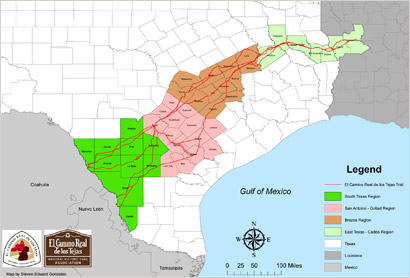
El Camino Real de los Tejas National Historic Trail Association Region Map
Mission
El Camino Real de los Tejas National Historic Trail Association seeks to protect the historic integrity of the trail, to educate and engage the public about its significance, and to promote resource development, interpretation, and tourism along its path.
Vision
For the trail:
El Camino Real de los Tejas NHT is a nationally recognized and protected cultural resource connecting nations, cultures, and places through time.
For the association:
ELCAT is a champion for the trail and achieves its work through the strength of its volunteers, partners, and staff.
Values
Collaboration:
- To preserve and protect shared resources
- To leverage expertise of partners, sharing best practices
- To provide access to federal, state and local governmental resources
Communication:
- Inform partners and users trail resources and opportunities
- Listen to diverse constituents
- Stay on message
Trust and Respect for:
- Authentication of trail resources
- Governance processes
- Partners
- Landowner’s property rights and autonomy over property
- Voluntary landowner participation in trail and association activities
Association Board
The Board of Directors is composed of eleven individuals from four geographic regions along the trail that are outlined in our Association Bylaws.
Association History
Since obtaining the status of a 501(c)3 non-profit organization in 2007, the Association has built a strong foundation through partnerships with local, state, and federal agencies, as well as individuals across Texas and Louisiana. Additionally, the Association has maintained relationships with partner organizations in Mexico and Spain.
Originally based in San Marcos at Texas State University, the Association has been housed in Austin since 2011. In addition to a volunteer eleven member board, the Association employs a full-time executive director, a part-time staff member, and multiple interns.